The mold is the heart of any injection molding project. A well-designed mold produces perfect parts for millions of cycles. A poor mold fails early, adds cost, and delays your launch. That is why choosing the right custom injection mold manufacturer is so important. At Miracles Manufacturing, we design and build molds in-house. Our team has nearly 30 years of experience. We work with you from the first sketch to the last part. This page explains our mold design and manufacturing services, our process, and why global clients trust us for their most complex projects.
Why Mold Design Matters
The Mold Controls Everything
The mold determines:
- Part quality – dimensions, surface finish, strength
- Cycle time – how fast parts are made
- Tool life – how many parts before maintenance
- Cost – both upfront and per part
A small mistake in design can cause big problems. Think about warpage, sink marks, or short shots. Most of these come back to the mold.
Experience Reduces Risk
When you work with an experienced custom injection mold manufacturer, you get more than steel. You get knowledge. We look at your part and ask: Will it fill right? Where will weld lines appear? Is the cooling balanced? We catch issues before steel is cut.
We have seen clients try to save money by using an inexperienced mold maker. The mold arrived late, did not work, and needed expensive rework. In the end, they paid more than if they had chosen quality from the start.
Our Mold Design Services

DFM Analysis – The First Step
Before we design anything, we do a Design for Manufacturing (DFM) review ( Our experienced engineers could pick up these problems too ). We look at your 3D model and give feedback on:
- Wall thickness – is it uniform?
- Draft angles – can the part eject?
- Rib and boss design – will they cause sinks?
- Gate location – where should the plastic enter?
- Ejection – how will the part come out?
We send you a DFM report with pictures and notes or direct feeback from experienced engineers. Most clients tell us this alone is worth working with us.
3D Mold Design
Our engineers use CAD software ( UG NX) to design the mold in 3D. You see exactly how the mold will look. We design:
- Core and cavity inserts
- Cooling channels – for fast, even cooling
- Ejection system – pins, sleeves, or blades
- Slides and lifters – for undercuts
- Gate and runner system – to control flow
Mold Flow Analysis
For complex parts, we run Moldflow simulations. This shows how plastic fills the cavity. It predicts weld lines, air traps, and pressure drops. We adjust the design before cutting steel. This saves time and money.
See our detailed design guidelines for injection molding
Mold Manufacturing – From Steel to Finished Tool
Steel Selection
We choose steel based on your volume and material.
| Steel Type | Best For | Properties |
|---|---|---|
| P20 | Standard production (up to 1M cycles) | Good machinability, tough |
| H13 | Abrasive materials (glass-filled) | Hard, wear-resistant |
| Stainless | Medical, food-grade molds | Corrosion resistant |
| Aluminum | Prototype, low volume (up to 10k) | Fast to machine, easy to modify |
CNC Machining
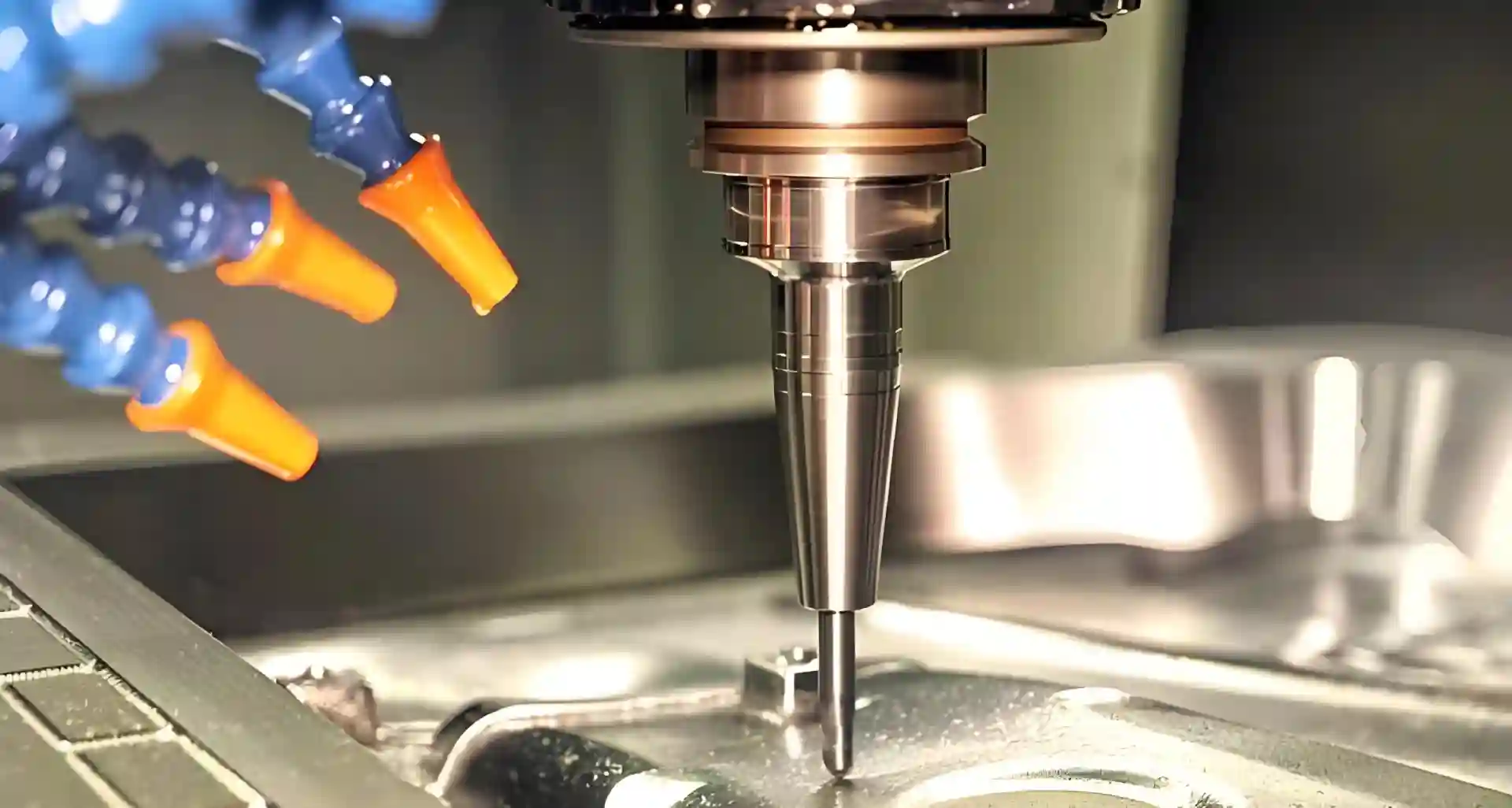
Our tool room has advanced CNC mills and EDMs. We machine the mold components to tight tolerances – often ±0.01 mm. We use high-speed machining for fine finishes.
EDM (Electrical Discharge Machining)
For complex shapes and sharp corners, we use EDM. Wire EDM cuts through hard steel. Sinker EDM makes detailed cavities.
Heat Treatment
After rough machining, we heat treat the steel. This hardens it for long life. Then we do finish machining and polishing.
Polishing and Texturing
Surface finish matters. We polish to SPI grades (A1, A2, B1, etc.). If you need texture, we work with trusted partners for mold texturing (MT, VDI finishes).
Some low-cost mold makers skip heat treatment or use cheap steel. The mold may look fine at first, but after 50,000 parts, it starts to wear. Cavities grow, parts change size, and you need a new mold. We build molds to last.
Types of Molds We Build
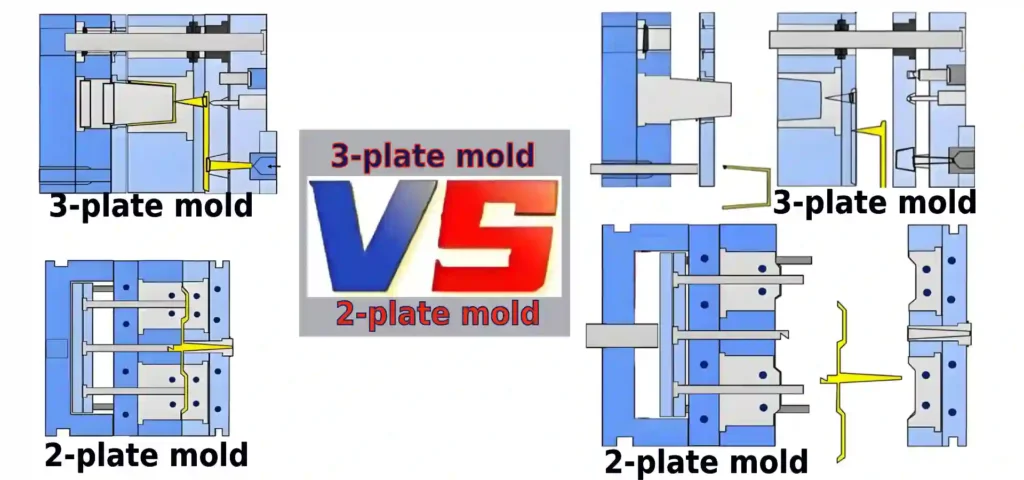
Two-Plate Molds
The simplest design. One parting line. Good for most parts. Low cost, easy to maintain.
Three-Plate Molds
Two parting lines. Allows the gate to be placed on top of the part. Runner and part separate automatically. Ideal for multi-cavity or center-gated parts.
Hot Runner Molds
The runner stays hot. No cold runner waste. Faster cycles. Best for high-volume production. We design and integrate hot runner systems from leading brands (Yudo, Husky, Mold-Masters).
Family Molds
One mold makes multiple different parts. Great for assemblies. Saves tooling cost. But all parts must be the same material and similar size.
Insert Molds
For overmolding metal or other materials. We design fixtures to hold inserts during molding. Common for threaded inserts, electrical contacts, and hybrid parts.
Two-Shot (Multi-Material) Molds
Two materials in one cycle. For soft-grip handles, multi-color parts, or seals. Complex but powerful.
Stack Molds
Two parting lines stacked. Doubles output without doubling machine size. For high-volume thin-wall parts.
See our specialty injection molding services
Complex Features – Slides, Lifters, and Unscrewing

Slides
When a part has holes or notches on the side, you need a slide. It moves sideways before ejection. We design angle pins, hydraulic cylinders, or cam actions to move slides.
Lifters
For internal undercuts (like snap-fit barbs), we use lifters. They move at an angle as the mold opens, releasing the feature.
Unscrewing Mechanisms
Threaded parts need to rotate out. We design rack-and-pinion or hydraulic unscrewing systems. Common for bottle caps, fittings, and medical connectors.
Collapsible Cores
For threads or undercuts that need to collapse inward. Complex but saves secondary operations.
Quality Assurance in Mold Making
We check every mold at multiple stages.
In-Process Inspections
During machining, we measure critical dimensions. We use CMM (coordinate measuring machine) for accuracy.
Mold Trial
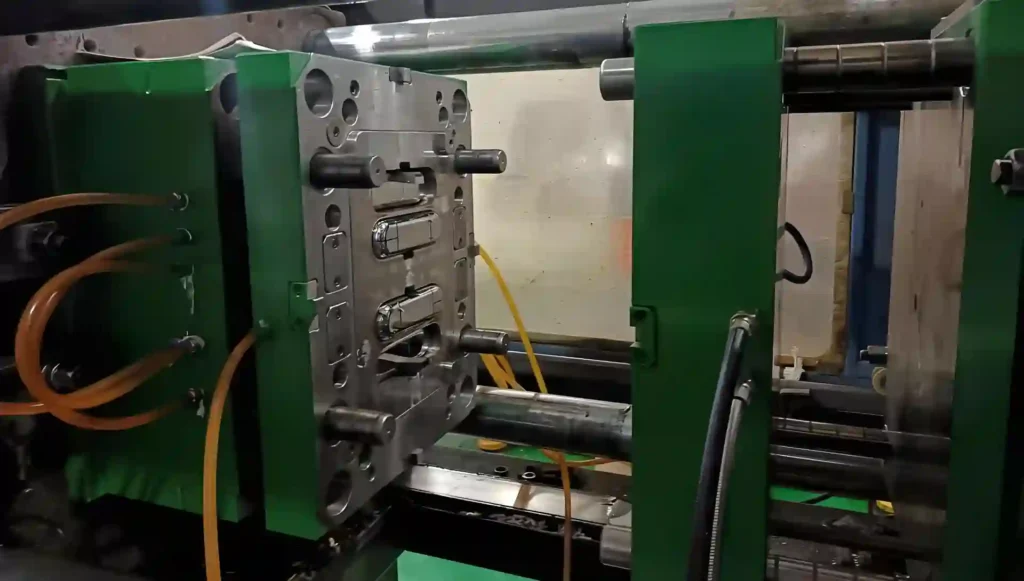
injection mold trial on molding machine
After assembly, we run the mold in our own injection machines. We test:
- Fill pattern – does it fill evenly?
- Ejection – do parts come out clean?
- Cooling – is cycle time as expected?
- Part quality – dimensions, surface, defects
We make adjustments until the parts meet your specs.
First Article Report
We send you samples with a detailed report. Dimensions, photos, material data. You approve before production starts.
Mold Maintenance and Repair
A good mold needs care. We offer:
- Preventive maintenance – cleaning, polishing, lubrication
- Repair – worn cavities, broken ejector pins
- Modifications – design changes, adding cooling lines
- Storage – safe, climate-controlled storage for your molds
Regular maintenance extends mold life and keeps parts consistent.
Neglecting mold maintenance is like never changing your car’s oil. Eventually, it breaks. We have seen molds that could have lasted years fail early because of poor maintenance. We can help you set up a schedule.
Our Mold Making Process – Step by Step
- Inquiry – You send a 3D model and requirements.
- DFM Review – We analyze design and send feedback.
- Quotation – We provide a detailed quote for mold and parts.
- Order Confirmation – You approve, we start.
- Mold Design – 3D design, mold flow analysis, cooling layout.
- Material Procurement – Steel ordered, certified.
- Machining – CNC, EDM, wire cutting.
- Heat Treatment – Hardening, tempering.
- Finishing – Polishing, texturing.
- Assembly – Fit all components, check movement.
- Mold Trial – Run in our machines, test parts.
- First Article Report – Send samples and report.
- Approval – You sign off.
- Production – We start molding your parts.
- Ongoing Support – Maintenance, repairs, modifications.
Why Choose Miracles Manufacturing for Your Mold
In-House Tool Room
We do not outsource. Our mold makers work next to our molding machines. If there is a problem, we fix it fast.
Experienced Team
Our lead engineers have nearly 30 years in mold design and building. They have seen thousands of parts and solved countless challenges.
Full Service
From DFM to mold building to production to secondary ops – we do it all. One partner, one responsibility.
Competitive Pricing
We build molds to your volume needs. No over-engineering, no cutting corners. You get the right mold at a fair price.
Frequently Asked Questions
Q1: How long does it take to build an injection mold?
A: Simple prototype molds: 3–5 weeks. Production molds: 8–12 weeks. Complex multi-cavity or hot runner molds may take longer.
Q2: How much does a custom injection mold cost?
A: It varies widely. A simple single-cavity mold might cost $3,000–$8,000. A complex production mold can be $30,000–$100,000+. We give detailed quotes based on your design.
Q3: Can you modify an existing mold?
A: Yes. We can add cooling lines, change gates, repair damage, or modify cavities. Send us your mold and requirements.
Q4: What file formats do you accept for mold design?
A: STEP, IGES, STP, X_T, and native files like SolidWorks or UG NX. STL is okay but less precise.
Q5: Do you offer mold sampling before production?
A: Absolutely. We run mold trials and send you samples with a full report. Production only starts after your approval.
Q6: What if my part design changes after the mold is made?
A: We can evaluate modifications. Sometimes a small change is possible by machining the mold. Major changes may need a new insert or mold.
Summary
Custom injection mold design and manufacturing is a core strength of Miracles Manufacturing. With in-house engineering, advanced CNC and EDM, and decades of experience, we deliver molds that perform. Whether you need a simple two-plate mold or a complex hot runner system with slides and lifters, we have the skills.
Contact us today to discuss your project. Let us build a mold that works – first time, every time.