
Many products today combine two or more materials in a single part. A toothbrush with a soft grip, an automotive button with a rigid core and flexible seal, or a two‑color logo on an electronic device. Two-shot injection molding – also called multi‑material molding – makes these parts in one automated cycle, eliminating assembly and improving reliability. At Miracles Manufacturing, we specialize in two‑shot molding using advanced rotary‑table machines and all‑electric precision. This page explains how the process works, the benefits, and why our experience with multi‑material injection molding ensures your project succeeds.
What Is Two-Shot Injection Molding?
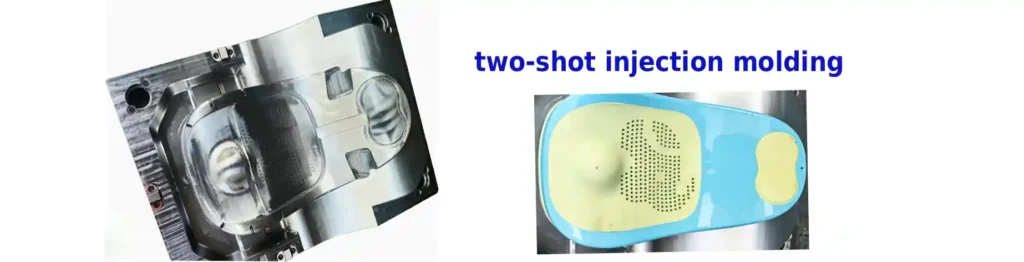
Two‑shot molding (also known as 2K molding, dual‑shot, or multi‑component molding) is a process where two different materials are injected into the same mold in a single cycle. The mold rotates or a core moves between shots, allowing the second material to bond to the first.
How it works:
- The first material (usually a rigid plastic) is injected into the mold.
- The mold opens slightly and rotates (or a core rotates), bringing the first‑shot part to a second cavity.
- The second material (often a softer TPE or a different color) is injected over or around the first.
- The finished two‑material part is ejected.
Benefits:
- No assembly – Parts come out ready to use.
- Strong bond – Materials bond chemically or mechanically.
- Faster cycles – One machine, one cycle.
- Consistent quality – No misalignment from separate assembly.
For a complete overview of our capabilities, visit our custom injection molding services page .
Why Choose Miracles for Two-Shot Molding
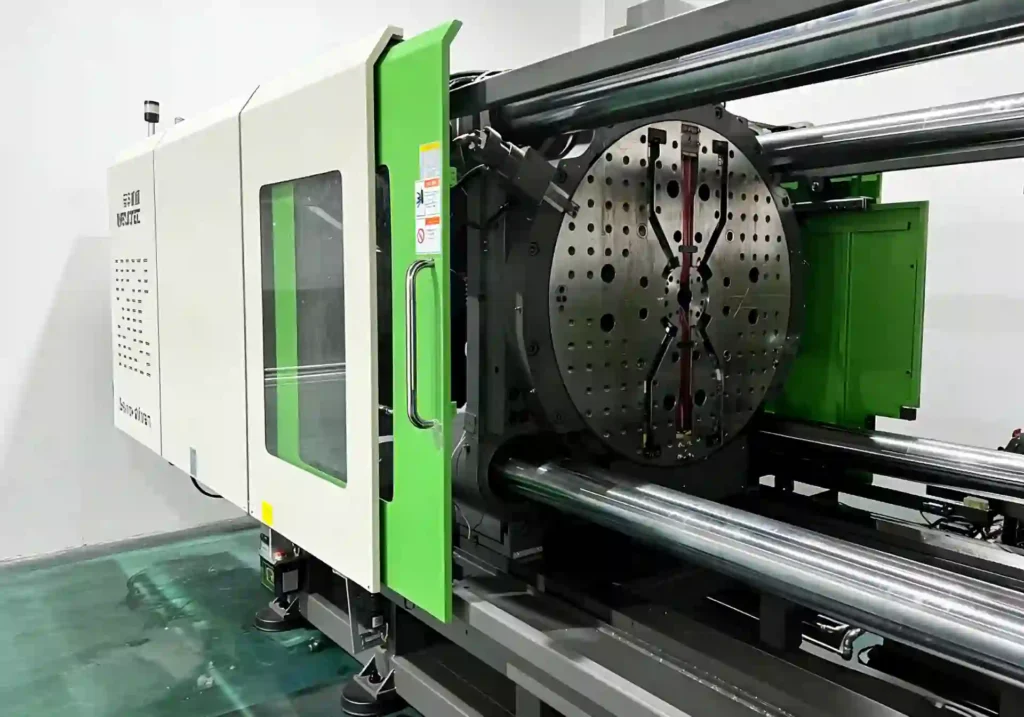
Advanced Equipment
We use rotary‑table two‑shot machines with all‑electric drives for precise control. Key features:
- ±0.01 mm repeatability
- Closed‑loop control of injection parameters
- Quick material changeovers
Material Compatibility Expertise
Not all materials bond well. We help you select compatible pairs:
- ABS + TPE (for soft‑grip handles)
- PC + TPE (for medical devices)
- PP + TPE (for consumer goods)
- Nylon + TPV (for automotive seals)
- PMMA + ABS (for two‑color cosmetic parts)
In‑House Mold Design
Two‑shot molds are complex, with rotating cores, hot runner systems, and precise alignment. Our toolmakers design and build these molds in‑house, ensuring they run reliably.
Process Optimization
We use mold flow simulation to predict how the two materials will interact – where the weld lines will form, how the bond line will behave, and whether shrinkage mismatch will cause warpage.
Real‑scenario example: A client needed a power tool handle with a rigid ABS core and a soft TPE overmold. The first‑shot core had undercuts that the TPE flowed into, creating a mechanical lock. Our two‑shot mold produced the handle in 45 seconds – 70% faster than a two‑step overmolding process.
For complex multi‑material projects, see our advanced injection molding capabilities .
Two-Shot vs. Overmolding
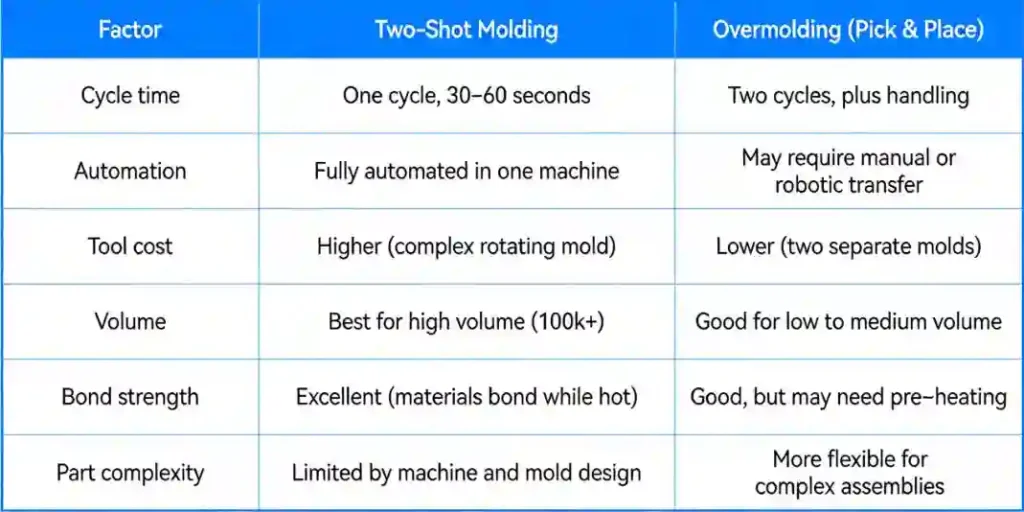
Both processes create multi‑material parts, but they differ:
| Factor | Two-Shot Molding | Overmolding (Pick & Place) |
|---|---|---|
| Cycle time | One cycle, 30–60 seconds | Two cycles, plus handling |
| Automation | Fully automated in one machine | May require manual or robotic transfer |
| Tool cost | Higher (complex rotating mold) | Lower (two separate molds) |
| Volume | Best for high volume (100k+) | Good for low to medium volume |
| Bond strength | Excellent (materials bond while hot) | Good, but may need pre‑heating |
| Part complexity | Limited by machine and mold design | More flexible for complex assemblies |
Which one is right for you?
- Choose two‑shot for high‑volume production where cycle time and automation matter.
- Choose pick‑and‑place overmolding for lower volumes or when materials are very different and need special handling.
For more on overmolding, see our insert molding and overmolding services.
Applications of Two-Shot Molding
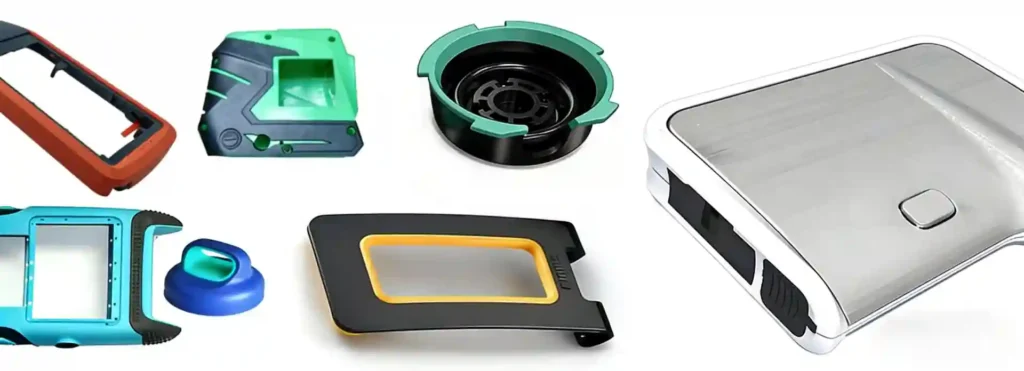
| Industry | Examples |
|---|---|
| Automotive | Soft‑touch buttons, gear shift knobs, seals |
| Medical | Syringe grips, catheter handles, multi‑density seals |
| Consumer | Toothbrushes, razors, power tools, kitchen utensils |
| Electronics | Waterproof seals, two‑color keypads, soft grips |
| Industrial | Anti‑vibration handles, dual‑durometer seals |
Key Design Considerations for Two-Shot Molding
Material Compatibility
For a chemical bond, the two materials must be compatible. Common compatible pairs are listed above. If materials do not bond chemically, you can use mechanical interlocks – undercuts, holes, or textured surfaces that the second material flows into.
Shrinkage Matching
If the two materials shrink at different rates, the part may warp. We use mold flow simulation to predict shrinkage and design the mold to compensate.
Bond Line Strength
The bond line is where the two materials meet. We design the interface to maximize surface area – using grooves, ribs, or textured surfaces – to increase bond strength.
Gate Location
The second shot must fill without disturbing the first. We place gates to avoid jetting or eroding the first material.
Part Ejection
Two‑shot parts can be tricky to eject. We design ejection systems that push on both materials without damaging them.
For detailed design guidelines, refer to our injection molding design guide .
Our Two-Shot Molding Process
Step 1 – Design Review
We analyze your 3D model and discuss material options. We identify potential issues – bond line strength, shrinkage mismatch, gate placement – and suggest improvements.
Step 2 – Material Selection
We recommend compatible materials and source them from trusted suppliers. We provide material data sheets and certificates.
Step 3 – Mold Design & Manufacturing
Our toolmakers design a two‑shot mold with:
- Rotary table or core rotation mechanism
- Hot runner systems for each material
- Cooling channels optimized for both shots
- Ejection system that handles the finished part
Step 4 – Sampling & Testing
We run samples and test:
- Bond strength (peel or tensile tests)
- Dimensional accuracy
- Visual appearance
- Functional performance
Step 5 – Production & Quality Control
Once approved, we move to production. We monitor key parameters and inspect parts throughout the run.
Common Defects and How to Avoid Them
| Defect | Cause | Solution |
|---|---|---|
| Poor bond between materials | Incompatible materials, low melt temp | Use compatible pair, increase temp |
| First shot moves during second shot | Insufficient cooling, high injection pressure | Increase cooling time, reduce pressure |
| Flash between materials | Mold misalignment, high pressure | Check alignment, reduce pressure |
| Warpage | Shrinkage mismatch | Match materials, design for shrinkage |
| Weld lines in second shot | Poor gate location, low temp | Relocate gate, increase temp |
| Short shot of second material | Second material not flowing | Increase speed, check gate size |
Real‑scenario risk: A client had a two‑shot part where the TPE overmold peeled off after a few cycles. We discovered the ABS core had a smooth surface – no mechanical lock. We added micro‑grooves to the core, and the bond became permanent.
Quality Assurance for Precision Parts
Our quality system includes:
- First article inspection report with full dimensions and CMM data
- In‑process SPC charts for critical dimensions
- Material certifications for every lot
- Capability studies (Cpk) to verify process capability
- 100% inspection for critical features (vision systems if needed)
- PPAP documentation for automotive and medical applications
We work to ISO 9001:2015 and can support ISO 13485 and IATF 16949 requirements.
Frequently Asked Questions
Q1: What materials can be used together in two-shot molding?
A: Common pairs include ABS/TPE, PC/TPE, PP/TPE, Nylon/TPV, and PMMA/ABS. We can advise based on your application.
Q2: How strong is the bond between materials?
A: With compatible materials, the bond can be as strong as the weaker material. We test bond strength to ensure reliability.
Q3: Can you mold two different colors of the same material?
A: Yes, two‑shot molding is ideal for two‑color parts, such as automotive logos or consumer products with multiple colors.
Q4: What is the minimum volume for two-shot molding?
A: Two‑shot molds are more expensive, so they are best for volumes above 50,000–100,000 parts. For lower volumes, pick‑and‑place overmolding may be more economical.
Q5: Can you combine two-shot molding with insert molding?
A: Yes, we can integrate inserts into the first shot, then overmold with a second material. This is advanced but possible.
Q6: How long does a two-shot mold take to build?
A: Typically 10–14 weeks, depending on complexity.
For troubleshooting bonding issues, see our injection molding defects guide .