Nylon (polyamide) is a family of engineering thermoplastics known for its strength, wear resistance, and ability to withstand high temperatures. From automotive gears to industrial bearings, nylon injection molding produces parts that must perform under demanding conditions. At Miracles Manufacturing, we offer a complete nylon injection molding service backed by decades of experience. We work with all common nylon grades, including nylon 6, nylon 6/6, and glass-filled formulations. This page explains our capabilities, the unique properties of nylon, and how we ensure your project succeeds.
Why Choose Miracles for Nylon Molding

Deep Material Knowledge
Nylon is hygroscopic – it absorbs moisture from the air. This affects processing and final part dimensions. Our engineers understand how to dry, mold, and condition nylon to achieve consistent, high-quality results.
Expertise with Glass-Filled Nylon
Glass-filled nylon (13%, 30%, 43% glass) offers exceptional stiffness and heat resistance. But it is also abrasive to molds. We design and build molds with hardened steel and wear-resistant coatings to handle glass-filled materials reliably.
In-House Mold Design
Nylon requires careful mold design – proper gate placement to minimize warpage, adequate venting, and cooling channels that ensure uniform shrinkage. Our in-house toolmakers build molds optimized for nylon.
Quality You Can Rely On
We inspect every nylon part for dimensions, strength, and appearance. For glass-filled grades, we verify that fiber orientation meets your requirements. You get parts that perform in the field.
For an overview of all our material capabilities, explore our expertise with engineering plastics .
What Makes Nylon Special
Nylon is a semi-crystalline thermoplastic with a unique set of properties:
Mechanical Strength
Nylon is incredibly strong and stiff, especially when glass-reinforced. It resists impact, fatigue, and creep better than many other plastics.
Wear Resistance
Nylon has a low coefficient of friction and excellent abrasion resistance. It is ideal for gears, bearings, and sliding components.
Heat Resistance
Depending on the grade, nylon can withstand continuous temperatures from 80°C to over 150°C. Glass-filled grades perform well under the hood.
Chemical Resistance
Nylon resists oils, fuels, solvents, and many chemicals. It is used extensively in automotive and industrial applications.
Moisture Absorption – The Double-Edged Sword
Nylon absorbs water from the environment. This can change dimensions and mechanical properties (it becomes more flexible when wet). For precision parts, we may need to condition the material after molding.
Common Nylon Grades
- Nylon 6 – good balance, easier to process
- Nylon 6/6 – higher melting point, stiffer
- Nylon 4/6 – highest heat resistance
- Nylon 11, 12 – lower moisture absorption
- Glass-filled (PA6-GF30, PA66-GF30) – enhanced strength and stiffness
- Impact-modified – extra toughness
If you are unsure which grade fits your application, our team can guide you. Discover our complete injection molding solutions for all materials .
Applications of Nylon Molded Parts
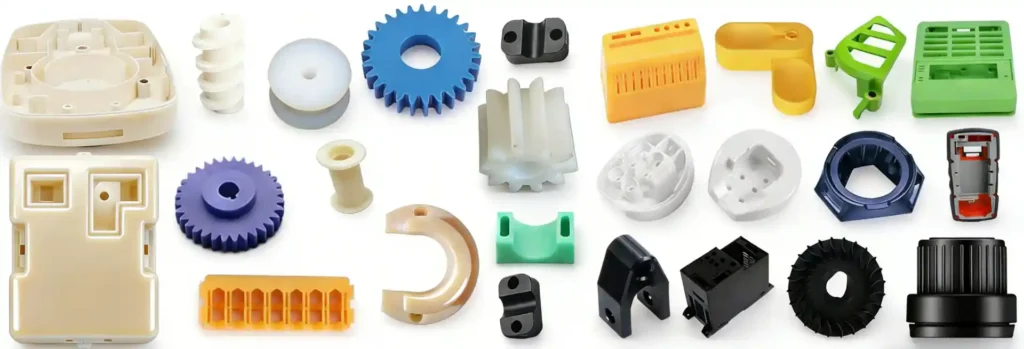
| Industry | Common Parts |
|---|---|
| Automotive | Under‑hood components, gears, connectors, fuel system parts |
| Industrial | Bearings, bushings, wear strips, conveyor components |
| Consumer | Power tool housings, sports equipment, zippers |
| Medical | Surgical instrument handles, device components (non‑implant) |
| Electrical | Cable ties, connectors, coil bobbins |
No matter your industry, we have the experience to produce nylon parts that meet your specifications.
Our Nylon Injection Molding Process

Step 1 – Design for Manufacturing (DFM)
Send us your 3D model. Our engineers review it for:
- Uniform wall thickness (avoid thick sections that cause sink marks)
- Draft angles (1–2° minimum)
- Gate location (to minimize warpage and weld lines)
- Rib and boss design (for strength without added mass)
We provide a DFM report with actionable feedback – often within 48 hours.
Step 2 – Material Selection
We help you choose the right nylon grade based on your application requirements: mechanical loads, temperature exposure, chemical resistance, and dimensional stability.
All materials come with full traceability and certifications upon request.
Step 3 – Drying (Critical for Nylon)
Nylon absorbs moisture rapidly. If molded wet, you get:
- Splay (silver streaks)
- Bubbles
- Reduced mechanical properties
- Surface defects
We dry nylon at 80°C for 4–6 hours (or longer for glass-filled grades) to below 0.2% moisture. We use dehumidifying dryers and moisture analyzers to ensure quality.
Step 4 – Mold Design & Manufacturing
Our toolmakers design molds specifically for nylon, considering:
- Shrinkage – nylon shrinks 0.5–1.5% depending on grade and wall thickness
- Gate design – larger gates reduce shear and fiber breakage in glass-filled grades
- Venting – adequate venting prevents burn marks
- Cooling – balanced cooling ensures uniform shrinkage and reduces warpage
- Ejection – robust ejector pins or lifters to handle sticky nylon parts
For glass-filled nylons, we use hardened tool steel (H13, D2) and wear coatings to extend mold life.
Step 5 – Molding & Quality Control
We run nylon on all-electric or hybrid machines for precise control of:
- Melt temperature (260–300°C depending on grade)
- Mold temperature (80–120°C)
- Injection speed (medium to high)
- Packing pressure (to compensate for shrinkage)
During production:
- First article inspection with CMM
- In-process dimensional checks
- Visual inspection
- Functional testing as required
Step 6 – Secondary Operations
Need post-molding work? We offer:
- Heat staking
- Ultrasonic welding
- Laser marking
- Assembly
- Custom packaging
For complex nylon parts requiring slides or lifters, consider our mold engineering services .
Glass-Filled Nylon Molding

Glass-filled nylon (PA6-GF30, PA66-GF30) is a popular choice for parts that need extra strength and heat resistance. But it brings challenges:
- Abrasive to molds – we use hardened steel and wear coatings
- Fiber orientation – affects shrinkage and warpage; we use mold flow simulation to predict and control it
- Higher shrinkage anisotropy – design must account for different shrinkage in flow and cross-flow directions
Our team has extensive experience with glass-filled nylons. We help you design parts that mold consistently and perform reliably.
For a detailed look at glass-filled nylon, see our detailed guide on glass-filled nylon .
Quality Assurance for Nylon Parts

Nylon parts demand extra care. Our quality process includes:
- Material verification – certificates of analysis for every lot
- Moisture testing – confirm drying before molding
- First article inspection – full dimensions, photos, notes
- In-process SPC – monitor critical dimensions
- Dimensional stability testing – measure after conditioning if required
- Functional testing – load, wear, or chemical resistance as needed
For automotive or industrial applications, we provide full documentation packages.
Frequently Asked Questions
Q1: What is the difference between nylon 6 and nylon 6/6?
A: Nylon 6/6 has a higher melting point and slightly better stiffness. Nylon 6 is easier to process. Both are excellent for most applications. We can help you choose.
Q2: Do you offer glass-filled nylon molding?
A: Yes, we regularly mold PA6-GF30, PA66-GF30, and other glass-reinforced grades. We design molds to handle the abrasive nature of glass fibers.
Q3: How does moisture affect nylon parts?
A: Nylon absorbs moisture from the air, which can change dimensions and make the part more flexible. For precision parts, we may condition parts after molding to stabilize them.
Q4: What wall thickness is recommended for nylon parts?
A: Typical walls are 1.5–3.0 mm. For glass-filled grades, thinner walls are possible due to higher strength. We can help optimize your design.
Q5: Can nylon be overmolded with TPE?
A: Yes, with proper material selection. We offer overmolding services for two-material parts.
Q6: What certifications do you provide for nylon parts?
A: We provide material certifications, dimensional reports, and upon request, PPAP level 3 for automotive applications.
For more technical details on nylon injection molding, refer to our comprehensive material selection guide .